In today's web development ecosystem, security is no longer an option; it is the foundation upon which everything else is built. If you browse any modern site, you will see the HTTPS protocol active. For years, the narrative has been: "Install a free certificate from Let's Encrypt and you'll be safe."
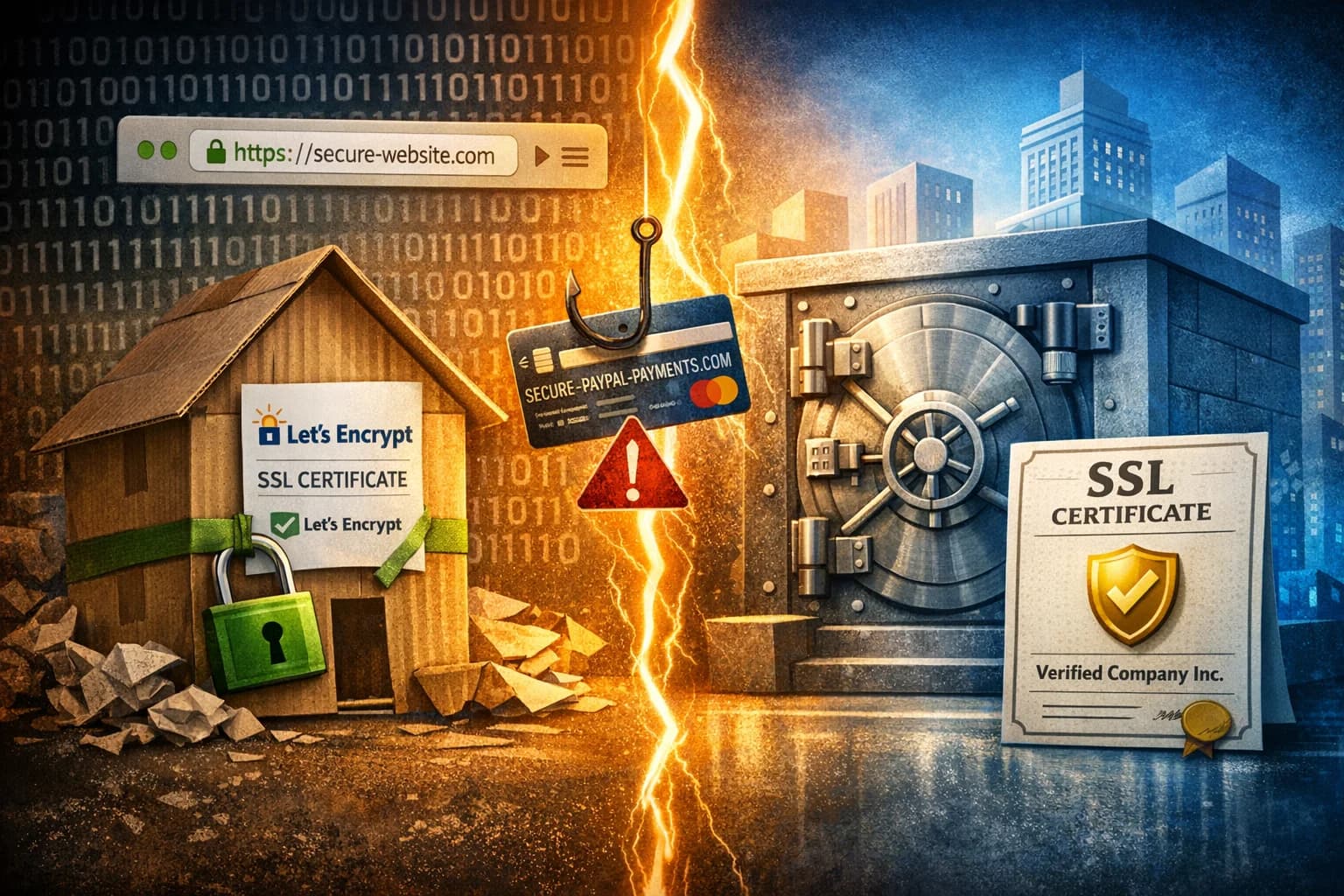
As experts at Blog Hostings Arena, we are here to tell you that while free certificates are a technological marvel, they are not a universal solution. For many businesses, relying exclusively on free options is like putting a reinforced steel door on a cardboard house.
1. The Revolution of Let's Encrypt and Free SSL
To understand why free isn't always enough, we must first respect what free SSL did for the web. Before 2014, obtaining an SSL certificate was a bureaucratic and expensive process. Let's Encrypt changed the game by offering automated Domain Validation (DV) certificates at no cost.
What does a free SSL do?
Encrypts communication: It protects data traveling between the user's browser and the server.
Removes the "Not Secure" warning: It meets the basic requirements of Google Chrome and other browsers.
Basic SEO factor: Google has used HTTPS as a ranking signal for years.
However, these certificates are anonymous. They only validate that you have control over the domain, not who you actually are or what your intentions might be.
2. The Limits of Domain Validation (DV)
The biggest issue with free SSL is that it is limited to Domain Validation. This means the certifying authority only checks that the applicant has access to the domain's DNS configuration.
For a personal blog or a niche site, this is usually enough. But for a company, an e-commerce platform, or a SaaS, DV validation has critical shortcomings:
Ease of Phishing: Criminals use free certificates too. A site called
secure-paypal-payments.comcan have its green padlock perfectly active, deceiving the user.Lack of Identity: The certificate says nothing about the company behind the website.
3. Premium SSL: Organization Validation (OV) and Extended Validation (EV)
This is where paid certificates come in. You aren't just paying for the encryption "file," but for an audit process.
Organization Validation (OV)
In an OV certificate, the issuing entity (such as Comodo or DigiCert) verifies that the company legally exists. If someone inspects the certificate, they will see your company's name and location. This adds a layer of authenticity that free SSL cannot offer.
Extended Validation (EV)
This is the gold standard. It requires an exhaustive investigation of the owner's identity. Although modern browsers no longer show the company name directly in the address bar (as they used to), the financial warranty and the presence in the certificate's code remain vital for large corporations.
4. The Key Factor: Financial Warranties
This is the point most developers ignore.
Let's Encrypt: $0 warranty. If the encryption is breached or the certificate fails due to an issuer error, you and your clients are on your own.
Paid SSL: They offer insurance ranging from $10,000 to $1.5 million USD.
If you manage an online store processing thousands of dollars a day, that warranty is not an expense—it’s liability insurance. In the event that a certificate failure compromises your customers' card data, you have legal and financial backing.
5. Management and Renewals: The Risk of "Auto-Renew"
Free certificates usually expire every 90 days. They rely on automation scripts to renew. What happens if the script fails? Your site is flagged as "Dangerous," your traffic drops to zero, and your SEO plummets within hours.
Paid certificates typically have a validity of one year or more (though current regulations push for shorter periods for security). Being a paid service, you have 24/7 technical support to resolve installation issues—something that simply doesn't exist in the "Open Source" world of free software.
6. Impact on SEO and Conversion
At Blog Hostings Arena, we analyze SEO obsessively. Does a paid SSL affect Google rankings more than a free one? Directly, no. Google only requires the site to be HTTPS.
But let's talk about indirect SEO:
Trust Flow: A user who feels the site is professional spends more time on it (Dwell Time).
Bounce Rate: On transactional sites, seeing trust seals (like Norton or Sectigo) reduces bounce rates.
Domain Authority: High-authority sites tend to invest in premium infrastructure. Google notices these quality patterns.
7. Multi-domain and Wildcards: Professional Flexibility
If you have a complex web ecosystem (subdomains like store.yourdomain.com, app.yourdomain.com, admin.yourdomain.com), managing free certificates for each can be a technical nightmare and increase points of failure.
A premium Wildcard certificate covers all your subdomains under a single set of keys and a single renewal date, drastically simplifying your server architecture and improving loading performance (SSL Handshake).
8. When to Use Which? (The Golden Rule)
To help you decide, we've created this quick guide for your blog:
Use Free SSL if: You have a personal blog, an informative niche site, or are in the development/testing stage.
Use Paid SSL (OV/EV) if: * You handle sensitive customer data.
You are a corporate brand that needs to protect its identity.
You sell products or services directly on the web.
You need a financial warranty to comply with legal regulations.
Conclusion: Don't Skimp on the Foundations
In 2026, free SSL is the minimum standard, but it is not the ceiling of security. A web professional knows that saving a few dollars a year does not compensate for the risk of a reputation crisis or a failed automatic renewal.
At Blog Hostings Arena, we recommend that if your project has commercial goals, you make the leap to a professional SSL. It’s not just a file; it’s trust, backing, and professionalism.